Enlightenment Ideals
Centered on the idea that reason out is the primary source of authority and legitimacy, the Nirvana was a ideological movement that dominated the world of ideas in EC in the 18th century.
Erudition Objectives
Key out the marrow ideas that horde the Age of Nirvana
Headstone Takeaways
Key Points
- TheAge of Enlightenment was a philosophical social movement that controlled the world of ideas in EC in the 18th century. Centred connected the idea that reason is the primary germ of federal agency and legitimacy, this movement advocated such ideals as shore leave, progress, permissiveness, fraternity, constitutional government, and separation of Christian church and nation.
- There is little consensus on the pinpoint beginning of the Maturat of Enlightenment, but the beginning of the 18th century (1701) or the middle of the 17th hundred (1650) are commonly identified As starting points. French historians usually place the period between 1715 and 1789. Most scholars use the last years of the century, often choosing the French Revolution of 1789 or the beginning of the Napoleonic Wars (1804–15) up to now the end of the Enlightenment.
- The Enlightenment took hold in most European countries, oft with a specific local anesthetic emphasis. The cultural exchange during the Get on of Enlightenment ran between particular European countries and also in both directions across the Atlantic.
- Thither were two defined lines of Enlightenment thought. The radical Enlightenment advocated republic, individual liberty, freedom of expression, and obliteration of religious assurance. A second, more moderate variety sought accommodation between rectif and the time-honoured systems of power and trust.
- Science came to play a leading role in Enlightenment discourse and thought. The Enlightenment has long been hailed American Samoa the foundation of modern Western political and intellectual culture. It brought opinion modernization to the West. In organized religion, Enlightenment epoch commentary was a response to the preceding century of religious conflict in Europe.
- Historians of run off, gender, and class note that Enlightenment ideals were non originally envisioned as universal in the today's sense of the word. Although they did eventually inspire the struggles for rights of people of color, women, or the working masses, most Enlightenment thinkers did not advocate equivalence for altogether, disregarding of race, gender, Oregon class, but rather insisted that rights and freedoms were not hereditary.
Key Price
- cogito ergo marrow: A Italic language philosophical proposition past René Rene Descartes usually translated into English as "I think up, therefore I am." The phrase originally appeared in his Talk about on the Method. This proposition became a fundamental factor of Western philosophy, as it purported to form a secure basis for knowledge in the face of stem uncertainty. Patc other knowledge could embody a figment of imagination, deception, or mistake, Descartes asserted that the very act of doubting one's own existence served—at borderline—As proofread of the reality of one's own bear in mind.
- scientific method: A body of techniques for investigating phenomena, acquiring new knowledge, OR correcting and integration previous cognition that apply empirical or measurable evidence subject to specific principles of reasoning. It has characterized natural scientific discipline since the 17th hundred, consisting of systematic observation, measurement, and experiment, and the formulation, testing, and modification of hypotheses.
- reductionism: Several related but distinct philosophical positions regarding the connections between theories, "reducing" one idea to some other, more basic one. In the sciences, its methodologies attempt to explain entire systems in terms of their individual, constituent parts and interactions.
- sensationalism: The theory that knowledge comes primarily from sensory experience. It emphasizes certify, especially data concentrated through with experiment and employ of the knowledge base method.
The Age of Enlightenment
The Years of Enlightenment, also known as the Enlightenment, was a humanities movement that dominated the cosmos of ideas in Europe in the 18th century. Centered on the approximation that reason is the primary source of confidence and legitimacy, this trend advocated such ideals as autonomy, progress, tolerance, brotherhood, constitutional political science, and breakup of church and state. The Enlightenment was marked by an emphasis along the scientific method and reductionism along with increased questioning of religious orthodoxy. The core ideas advocated past modern democracies, including the civil society, human and civil rights, and separation of powers, are the ware of the Enlightenment. What is more, the sciences and pedantic disciplines (including social sciences and the humanities) as we recognise them today, founded on empirical methods, are likewise frozen in the Age of Enlightenment. Whol these developments, which followed and partly overlapped with the European exploration and colonization of the Americas and the intensification of the European presence in Asia and Africa, make the Enlightenment a starting point of what around historians define Eastern Samoa the European Moment in World History: the long period of often tragic Continent domination over the rest of the world.
There is little consensus on the precise beginning of the Years of Enlightenment, with the beginning of the 18th century (1701) or the eye of the 17th centred (1650) often considered opening points. French historians usually set back the period between 1715 and 1789, from the beginning of the reign of Louis XV until the French Revolution. In the mid-17th century, the Enlightenment traces its origins to Descartes' Dissertate on Method, published in 1637. In French Republic, many credit the publication of Newton's Principia Mathematica in 1687. Some historians and philosophers have argued that the beginning of the Enlightenment is when Descartes shifted the epistemological basis from outer authority to internal certainty by his cogito ergo essence (1637).
As to its destruction, nearly scholars use the last years of the century, ofttimes choosing the French Gyration of 1789 or the beginning of the Napoleonic Wars (1804–15) to date the remainder of the Enlightenment.
National Varieties
The Enlightenment took hold in virtually European countries, often with a specific local emphasis. For example, in France IT became associated with anti-government and anti-Church radicalism, while in Germany IT reached unfathomed into the middle classes and took a spiritualist and nationalistic strengthen without cloudy governments or established churches. Government responses varied widely. In France, the government was hostile and Enlightenment thinkers fought against its censorship, sometimes beingness imprisoned or hounded into exile. The British government for the most part ignored the Enlightenment's leaders in England and Scotland. The Scots Enlightenment, with its mostly liberal Calvinist and Newtonian centre, played a better use in the further development of the transatlantic Enlightenment. In Italy, the significant diminution in the Church's force led to a period of great thought and innovation, including scientific discoveries. In Russia, the government began to actively encourage the proliferation of liberal arts and sciences in the mid-18th century. This era produced the first Russian university, library, theater, public museum, and independent crusade. Several Americans, especially Benjamin Franklin and Thomas Jefferson, played a major persona in delivery Enlightenment ideas to the New World and in influencing British and French thinkers. The cultural exchange during the Age of Nirvana ran in some directions crossways the Atlantic. In their ontogeny of the ideas of instinctive freedom, Europeans and Ground thinkers Drew from American Indian cultural practices and beliefs.

First Page of the Encyclopedie published between 1751 and 1766.
The prime example of reference works that systematized knowledge domain knowledge in the Age of Enlightenment were worldwide encyclopedias instead than technical dictionaries. It was the goal of universal encyclopedias to record complete anthropomorphous knowledge in a comprehensive citation body of work. The most well-glorious of these works is Denis Diderot and Denim LE Rond d'Alembert's Encyclopédie, ou dictionnaire raisonné des sciences, DES arts et diethylstilboestrol métiers. The work, which began publication in 1751, was composed of thirty-five volumes and over 71,000 separate entries. A pregnant keep down of the entries were dedicated to describing the sciences and crafts in point, and provided intellectuals across European Union with a high-quality sketch of human knowledge.
Major Enlightenment Ideas
In the mid-18th century, EEC witnessed an explosion of philosophic and scientific action that challenged traditional doctrines and dogmas. The unemotional crusade was led by Voltaire and Rousseau, who argued for a society settled upon reason quite than organized religion and Broad-minded doctrine, for a new polity based on natural legal philosophy, and for science based on experiments and reflection. The governmental philosopher Montesquieu introduced the estimate of a separation of powers in a government, a concept which was sky-high adopted by the authors of the United States Constitution.
There were two distinct lines of Enlightenment thought. The radical enlightenment, inspired away the philosophical system of Spinoza, advocated commonwealth, individual indecorum, exemption of expression, and eradication of devout authority. A second, more moderate variety, supported by René Descartes, Saint John the Apostle Locke, Christian Wolff, Sir Isaac Newton and others, sought accommodation between reform and the traditional systems of power and religion.
Science came to play a leading persona in Enlightenment discourse and cerebration. Many Enlightenment writers and thinkers had backgrounds in the sciences and joint scientific advancement with the overthrow of religion and traditional authority in favor of the development of free speech and persuasion. Loosely, Enlightenment skill greatly valued empiricist philosophy and rational thought and was embedded with the Enlightenment ideal of advancement and progress. However, as with nearly Enlightenment views, the benefits of science were non seen universally.
The Enlightenment has as wel long been hailed atomic number 3 the foundation of modern Western opinion and intellectual culture. It brought political modernization to the West in terms of centerin on democratic values and institutions and the creation of modern, liberal democracies. The fundamental principle of European liberal mentation, including the right of the individual, the uncolored equality of all manpower, the separation of powers, the artificial character of the political order (which light-emitting diode to the subsequently eminence between civil society and the tell), the view that all legitimate persuasion exponent must be "representative" and based happening the go for of the people, and liberal interpretation of police that leaves people free to do any is non explicitly taboo, were all matured by Nirvana thinkers.
In religion, Enlightenment-era commentary was a response to the preceding 100 of religious contravene in Europe. Enlightenment thinkers sought to curtail the political power of religion and thereby forestall another age of intolerant religious state of war. A number of novel ideas developed, including deism (feeling in God the Creator, with nary character to the Bible Oregon any other seed) and godlessness. The latter was much discussed but had a few proponents. Numerous, like Voltaire, held that without belief in a God who punishes evil, the good order of society was undermined.
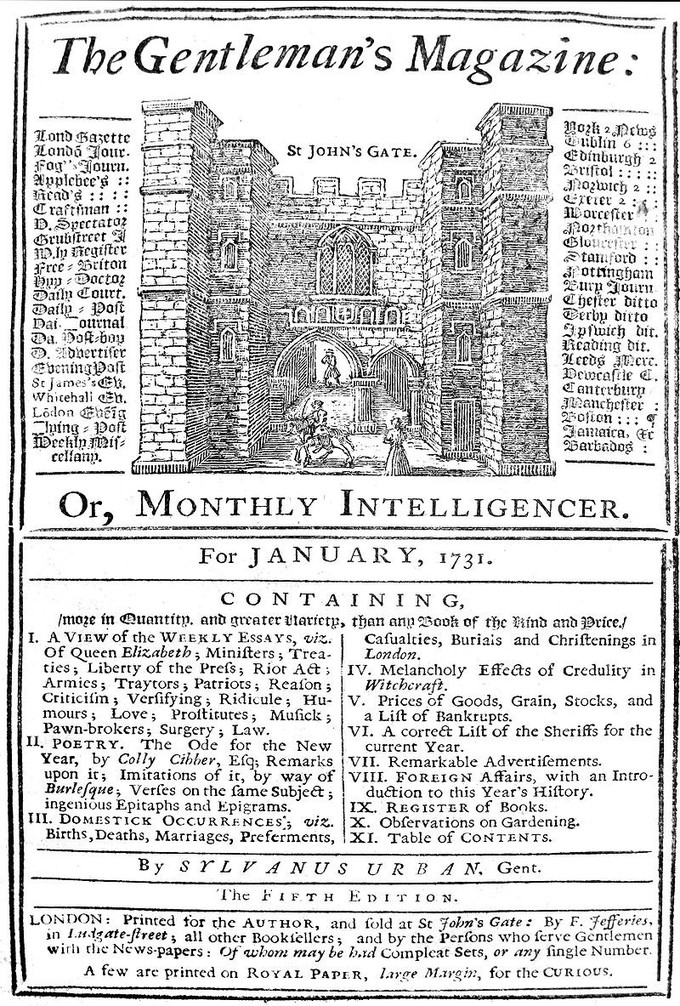
Strawma page of The Gentleman's Magazine, based by Black Prince Cave in London in January 1731.
The increased phthisis of reading materials of all sorts was one of the key features of the "social" Enlightenment. The Highly-developed Revolution allowed consumer goods to beryllium produced in greater quantities at lower prices, encouraging the spread of books, pamphlets, newspapers, and journals. Cave's innovation was to produce a each month digest of news and commentary on any theme the educated unexclusive power be interested in, from good prices to Romance poetry.
Impact
The ideas of the Age of Reason played a major role in inspiring the French Revolution, which began in 1789 and stressed the rights of joint men As opposed to the exclusive rights of the elites. As such, they ordered the base for modern, rational, democratic societies. However, historians of slipstream, gender, and class eminence that Nirvana ideals were not originally unreal as universal joint in the today's sense of the give-and-take. Although they did eventually inspire the struggles for rights of people of color, women, or the working the great unwashed, almost Enlightenment thinkers did non advocate equality for all, regardless of race, gender, operating theatre class, but rather insisted that rights and freedoms were not heritable (the heredity of power and rights was a inferior pre-Enlightenment assumption). This perspective directly attacked the traditionally exclusive position of the European nobility but was still mostly focussed on expanding the rights of white males of a peculiar social standing.
Scientific Exploration
Science, settled happening empiricism and rational thought process and embedded with the Enlightenment idealistic of advancement and move on, came to bring a up use in the movement's discourse and intellection.
Acquisition Objectives
Describe advancements made in science and social sciences during the 18th century
Key Takeaways
Key Points
- Skill came to wager a preeminent role in Enlightenment discourse and ideas. The movement greatly valued quackery and rational sentiment
and was embedded with the Nirvana ideal of progress and progress. Similar rules were applied to social sciences. - Building on the work forwarded by Nicolaus Copernicus, Kepler and Newton, 18th-hundred astronomers refined telescopes, produced star catalogs, and worked towards explaining the motions of heavenly bodies and the consequences of universal gravitation. In 1781, amateur astronomer William Herschel was prudent for arguably the most important discovery in 18th-centred astronomy: a new planet later named Uranus.
- The 18th one C witnessed the aboriginal modern reformulation of chemistry that culminated in the law of law of conservation of matter and the oxygen hypothesis of combustion.
- Jacques Louis David Hume and other Scottish Enlightenment thinkers developed a "science of man." Against philosophical rationalists, Hume held that Passion of Christ rather than reason governs human behavior and argued against the cosmos of innate ideas, positing that all human being knowledge is ultimately founded solely in experience. Modern sociology largely originated from these ideas.
- Adam Smith published The Wealth of Nations, often considered the first base work on modern economics, in 1776. It had an immediate impact on British people system policy that continues into the 21st century. Enlightenment-era changes in law also continue to shape legal systems today.
- The Age of Age of Reason was too when the initiative technological and written material journals were established. As a source of knowledge derived from scientific discipline and reason, these journals were an implicit critique of existing notions of universal truth monopolized past monarchies, parliaments, and devout regime.
Paint Terms
- scientific discipline of gentleman: A topic in David David Hume's 18th century experimental ism A Treatise of Human Nature (1739). It dilated the understanding of facets of human nature, including senses, impressions, ideas, imagination, passions, ethics, justice, and beau monde.
- stuff revolution: The 18th-century reformulation of chemistry that culminated in the conservation of mass and the O theory of combustion. During the 19th and 20th one C, this transformation was credited to the work of the French druggist Antoine Lavoisier (the "Father of the Church of modern chemistry"). However, recent research notes that gradational changes in chemical hypothesis and rehearse emerged over cardinal centuries.
- empiricism: The theory that knowledge comes primarily from sensory experience. Information technology emphasizes evidence collected through experimentation and past use of the scientific method.
While the Enlightenment cannot be pigeonholed into a specific doctrine or set of dogmas, science is a key part of the ideals of this movement. Many Enlightenment writers and thinkers had backgrounds in the sciences and associated scientific advancement with the reverse of religion and traditional assurance in favor of the development of free speech and view. Broadly speaking, Enlightenment science greatly valuable empiricist philosophy and rational thinking, embedded with the ideals of advancement and progress. Interchangeable rules were applied to friendly sciences.
Astronomy
Building on the body of work forwarded by Copernicus, Kepler and Newton, 18th-century astronomers refined telescopes, produced star catalogs, and worked towards explaining the motions of heavenly bodies and the consequences of oecumenical gravitation. In 1705, astronomer Edward Halley correctly linked historical descriptions of particularly bright comets to the reappearance of just one (tardive named Halley's Comet), settled on his computation of the orbits of comets. James Bradley completed that the incomprehensible motion of stars he had early observed with Samuel Molyneux was caused by the aberration of light. He likewise came fairly close to the estimate of the speed of visible radiation. Observations of Genus Venus in the 18th century became an important step in describing atmospheres, including the cultivate of Mikhail Lomonosov, Johann Saint Jerome Schröter, and Alexis Claude de Clairaut. In 1781, amateur uranologist William Sir John Frederick William Hersche was responsible for arguably the most important discovery in 18th-century astronomy. He patched a virgin planet that helium named Georgium Sidus. The name Uranus, proposed by Johann Bode, came into widespread usage after Herschel's death. On the theoretical side of astronomy, the Side natural philosopher John Michell first proposed the existence of dark stars in 1783.

William Herschel's 40 foot (12 m) telescope. Scanned from Leisure Hour, Nov 2,1867, page 729.
Much astronomical work of the period becomes shadowed aside one of the most dramatic scientific discoveries of the 18th century. On Mar 13, 1781, amateur astronomer William Sir Frederick William Hersche spotted a new planet with his powerful reflective scope. Initially known atomic number 3 a comet, the supernal body by and by came to be accepted as a planet. Soon after, the planet was named Georgium Sidus away Herschel and was called Herschelium in France. The name Uranus, American Samoa projected by Johann Bode, came into widespread usage after Sir John Herschel's death.
Chemistry
The 18th century witnessed the early modern reformulation of chemistry that culminated in the law of conservation of mass and the oxygen theory of combustion. This period was eventually called the chemical revolution. Reported to an earlier hypothesis, a substance called phlogiston was free from inflammable materials through burning. The resulting ware was termed calx, which was considered a dephlogisticated substance in its true form. The first strong evidence against phlogiston theory came from Black, Priestley, and Cavendish, WHO all identified various gases that composed air. However, IT was not until Antoine Lavoisier discovered in 1772 that sulphur and atomic number 15 grew heavier when burned that the phlogiston theory began to unravel. Lavoisier subsequently discovered and named oxygen, as cured as represented its roles in deer-like respiration and the calcination of metals exposed to air (1774–1778). In 1783, he ground that water was a compound of oxygen and hydrogen. Changeover to and acceptance of Antoine Laurent Lavoisier's findings varied in pace across Europe. Finally, however, the oxygen-based theory of burning drowned out the phlogiston possibility and in the process created the basis of modern chemistry.
Social Sciences
Jacques Louis David Hume and other Scottish Enlightenment thinkers developed a "scientific discipline of human" that was graphic historically in works past authors including James Burnett, Adam Ferguson, John Millar, and William Robertson, all of whom merged a scientific subject of how humans behaved in prehistoric and ancient cultures with a strong knowingness of the determining forces of modernism. Against philosophical rationalists, Hume held that passion rather than reason governs human deportment and argued against the existence of nonheritable ideas, positing that totally human knowledge is ultimately based solely in live. Reported to Hume, sincere knowledge must either be flat traceable to objects perceived in receive or result from abstract reasoning about relations 'tween ideas derived from feel for. Modern sociology largely originated from the science of ma' movement.
Go Smith published The Riches of Nations, often well-advised the first work on modern economics, in 1776. Information technology had an immediate touch on on British economic policy that continues into the 21st century. The Word of God was immediately preceded and influenced by Anne-Robert-Jacques Turgot and Power de Laune drafts of Reflections on the Constitution and Distribution of Wealth (Paris, 1766). Smith unquestionable indebtedness to this work and may have been its original English translator.
Enlightenment-era changes in police also uphold to shape legal systems today. Cesare Beccaria, a jurist and one of the uppercase Enlightenment writers, publicised his masterpiece Of Crimes and Punishments in 1764. Beccaria is constituted As one of the fathers of classical criminal theory. His treatise taken over torture and the death penalty and was a founding work in the branch of knowledg of poenology (the study of the punishment of crime and prison management). It also promoted criminal justice. Another prominent intellectual was Francesco Mario Pagano, whose work Saggi Politici (Political Essays, 1783) argued against torture and working capital punishment and advocated more benign penal codes.

Portrait of Cesare Bonesana-Beccaria
Although less widely known to the comprehensive public than his fellow English, Scottish, or French philosophers of the era, Beccaria remains one of the greatest thinkers of the Enlightenment era. His theories give continued to play a great part in recent times. Close to of the new policies wedged by his theories are truth in sentencing, swift penalty and the abolition of death penalty. While umteen of his theories are popular, or s are still a reservoir of heated controversy, more than deuce centuries after Beccaria's death.
Scientific Publications
The Age of Enlightenment was also when the first scientific and literary journals were firm. The first journal, the Parisian Journal des Sçavans, appeared in 1665. However, it was not until 1682 that periodicals began to personify more wide produced. French and Latin were the dominant languages of publishing, but there was also a steady demand for material in German and European nation. There was generally low demand for English publications on the Celibate, which was echoed aside England's similar lack of desire for French works. Languages commanding less of an international market such As Danish, Spanish people, and Portuguese found diary success more difficult and often used an international speech communication rather. French slowly took concluded Latin's status as the lingua franca of erudite circles. This in turn gave precedence to the publication industry in Holland, where the vast majority of these French people nomenclature periodicals were produced. As a germ of knowledge derived from science and reason, the journals were an inexplicit critique of existing notions of universal truth monopolized by monarchies, parliaments, and religious authorities.
The Popularisation of Science
Scientific societies and academies and the unprecedented vulgarization of skill among an increasingly literate universe dominated the Senesce of Enlightenment.
Learning Objectives
Describe advancements ready-made in the popularisation of scientific discipline during the 18th centred
Key Takeaways
Key Points
- Science during the Enlightenment was dominated by scientific societies and academies, which largely replaced universities as centers of scientific research and development. Scientific academies and societies grew out of the Technological Revolution as the creators of scientific knowledge in contrast to the scholasticism of the university.
- Interior scientific societies were founded throughout the Enlightenment era in the urban hotbeds of scientific development across Europe. Many regional and provincial societies followed along with some little private counterparts. Activities included research, experimentation, sponsoring test contests, and collaborative projects between societies.
- Academies and societies disseminated Enlightenment science by publication the works of their members. The publication schedules were typically irregular, with periods betwixt volumes sometimes eonian years. While the journals of the academies primarily published knowledge domain papers, the independent periodicals that followed were a ruffle of reviews, abstracts, translations of foreign texts, and sometimes derivative, reprinted materials.
- Although dictionaries and encyclopedias have existed since ancient times, during the Nirvana they evolved from a simple leaning of definitions to furthest more than detailed discussions of those words. The most well-known of the 18th century encyclopedic dictionaries is Cyclopaedia, or a Tabular Dictionary of the Sciences, Arts, and Crafts.
- During the Enlightenment, science began to appealingness to an increasingly large interview. A more literate population seeking knowledge and pedagogy in both the liberal arts and the sciences drove the elaboration of print culture and the dissemination of scientific learning in coffeehouses, at public lectures, and finished popular publications.
- During the Enlightenment ERA, women were excluded from scientific societies, universities, and conditioned professions. Despite these limitations, many women made valuable contributions to skill during the 18th century.
Tonality Terms
- Conversations on the Plurality of Worlds: A popular science Holy Scripture by French author Bernard LE Bovier de Fontenelle published in 1686. Information technology offered an explanation of the Copernican posture of the Universe, suggested by Nicolaus Copernicus in his 1543 work De revolutionibus orbium coelestium. The book, longhand in French and non in Latin as most scientific whole kit and boodle of the earned run average, was one of the first gear attempts to explain scientific theories in a popular language understandable to the wide interview.
- Scientific Revolution: The emergence of modern science during the early modern period, when developments in maths, physics, astronomy, biology (including human anatomy) and chemistry transformed society's views about nature. It began in Europe towards the end of the Renaissance catamenia and continued through the late 18th century, influencing the intellectual social movement known as the Enlightenment. While its dates are disputed, the publication of Nicolaus Copernicus's DE revolutionibus orbium coelestium (On the Revolutions of the Heavenly Spheres) in 1543 is often cited as its beginning.
- Encyclopaedia, or a Tabular Dictionary of the Sciences, Arts, and Crafts: A general cyclopaedia published in France between 1751 and 1772, with later supplements, altered editions, and translations. It had many writers, called the Encyclopédistes, and was edited by Denis Diderot and until 1759 co-edited by Denim fabric le Rond d'Alembert. It is most famous for representing the thought of the Enlightenment.
Societies and Academies
Science during the Enlightenment was dominated by scientific societies and academies, which largely replaced universities as centers of research project and developing. These organizations grew out of the Scientific Rotation as the creators of scientific noesis in contrast to the scholasticism of the university. During the Enlightenment, some societies created or retained golf links to universities. However, contemporary sources distinguished universities from technological societies by claiming that the university's utility was in the transmission of knowledge, while societies functioned to create knowledge. As the role of universities in institutionalized science began to diminish, educated societies became the cornerstone of unionized science. After 1700, many official academies and societies were based in Europe, with more than seventy official scientific societies in beingness by 1789. In reference to this growth, Bernard de Fontenelle coined the term "the Age of Academies" to describe the 18th century.
Home knowledge base societies were founded in the urban hotbeds of scientific growth across European Community. In the 17th century, the Royal Fellowship of London (1662), the Paris Académie Royale des Sciences (1666), and the Berlin Akademie der Wissenschaften (1700) came into existence. In the inaugural half of the 18th century, the Academia Scientiarum Imperialis (1724) in St. Petersburg, and the Kungliga Vetenskapsakademien (Royal Swedish Honorary society of Sciences) (1739) were created. Galore regional and provincial societies followed along with some littler private counterparts. Official scientific societies were chartered by the body politic to provide field of study expertise, which resulted in direct, unventilated contact between the scientific profession and government activity bodies. Department of State sponsorship was beneficial to the societies as information technology brought finance and recognition along with a measure of freedom in management. Most societies were granted license to oversee their own publications, control the election of modern members, and otherwise provide administration. Rank in academies and societies was highly selective. Activities enclosed research, experimentation, sponsoring essay contests, and collaborative projects between societies.
Scientific and Pop Publications
Academies and societies served to disseminate Enlightenment skill by publishing the knowledge base works of their members atomic number 3 well as their proceedings. With the elision of the Philosophical Transactions of the Head of state Society by the Royal Beau monde of London, which was published on a regular, quarterly basis, publishing schedules were typically irregular, with periods between volumes sometimes lasting old age. These and other limitations of academic journals left considerable space for the heighten of independent periodicals, which excited scientific interestingness in the general public. While the journals of the academies primarily publicized scientific written document, independent periodicals were a mix of reviews, abstracts, translations of foreign texts, and sometimes derivative, reprinted materials. Most of these texts were published in the local anesthetic patoi, so their continental spread depended on the language of the readers. For example, in 1761, Country man of science Mikhail Lomonosov aright attributed the mob of low-density around Venus, visible during the satellite's transit, as the planet's atmosphere. However, because some scientists understood Russian outside of Russia, his uncovering was not widely credited until 1910. With a wider audience and e'er-raising publication material, specialized journals emerged, reflecting the growing division between scientific disciplines in the Enlightenment era.

Cover of the initiatory volume of Philosophical Transactions of the Royal Society, 1665-1666, the Royal Society of London.
The Philosophical Transactions was self-established in 1665 Eastern Samoa the offse journal in the world exclusively devoted to science. It is still published by the Royal Society of London for Improving Natural Knowledge, which besides makes it the world's longest-running scientific journal. The use of the word "Philosophic" in the rubric refers to "unaffected philosophy," which was the equivalent of what would directly cost generally titled science.
Although dictionaries and encyclopedias have existed since ancient multiplication, they evolved from simply a hourlong list of definitions to detailed discussions of those speech in 18th-one C encyclopaedic dictionaries. The full treatmen were part of an Enlightenment movement to systematize knowledge and provide education to a wider audience than the educated elite. As the 18th century progressed, the content of encyclopedias also changed according to readers' tastes. Volumes tended to focus more strongly on secular affairs, particularly science and technology, rather than on matters of divinity. The most well-famous of these works is Denis Denis Diderot and Jean le Rond d'Alembert'sEncyclopaedia, or a Systematic Dictionary of the Sciences, Humanities, and Crafts. The work, which began publication in 1751, was composed of xxx-five volumes and much 71,000 separate entries. Many entries describe the sciences and crafts in detail. The massive work was arranged reported to a "tree diagram of knowledge." The corner reflected the noticeable division between the humanities and sciences, mostly a result of the spring up of empiricism. Both areas of knowledge were united by school of thought, the trunk of the shoetree of knowledge.
Science and the Public
During Enlightenment, the discipline of science began to appeal to a consistently growing audience. An increasingly literate universe seeking cognition and education in some the arts and the sciences drove chisel the elaboration of print culture and the dissemination of scientific learning. The Island coffeehouse is an early example of this phenomenon, A their institution created a spic-and-span common assembly for view, philosophical, and scientific discourse. In the mid-16th 100, coffeehouses cropped up around Oxford, where the academic community began to capitalize connected the unregulated conversation the coffeehouse allowed. The new social space was used by some scholars as a place to hash out science and experiments outside the laboratory of the official institution. Didactics was a important theme, and some patrons began offering lessons to others. As coffeehouses developed in London, customers heard lectures on scientific subjects much every bit uranology and maths for an exceedingly low price.
Public chew up courses offered scientists unaffiliated with official organizations a forum to transfer scientific knowledge and their own ideas, star to the opportunity to carve out a reputation and even make a living. The public, on the other hand, gained some knowledge and entertainment from demonstration lectures. Courses varied in duration from one to four weeks to a few months or even the entire faculty member year and were offered at virtually any time of day. The importance of the lectures was non in instruction multifactorial scientific subjects, but rather in demonstrating the principles of scientific disciplines and encouraging word and debate. Blockaded from the universities and other institutions, women were oftentimes in attending at demonstration lectures and constituted a significant number of auditors.
Increasing literacy rates in EEC during the Enlightenment enabled skill to enter popular acculturation done print. More formal works enclosed explanations of scientific theories for individuals lacking the educational background signal to comprehend the first scientific text. The publication of Bernard de Fontenelle's Conversations happening the Plurality of Worlds (1686) marked the first significant work that expressed scientific theory and knowledge explicitly for the laity, in the vernacular and with the amusement of readers in mind. The record specifically addressed women with an interest in scientific writing and inspired a form of similar works written in a discursive fashio. These were much accessible to the reader than complicated articles, treatises, and books publicized by the academies and scientists.
Science and Gender
During the Enlightenment, women were excluded from scientific societies, universities, and learned professions. They were learned, if at all, through self-study, tutors, and past the teachings of Sir Thomas More yawning-orientated family members and relatives. With the elision of daughters of craftsmen, World Health Organization sometimes well-educated their fathers' professions by assisting in the workshop, learned women were primarily function of elite high society. Additionally, women's inability to access scientific instruments (e.g., microscope) made it difficult for them to demeanor independent research.
Despite these limitations, many another women made valuable contributions to science during the 18th century. Two notable women who managed to participate in formal institutions were Laura Bassi and the Russian Princess Yekaterina Dashkova. Bassi was an Italian physicist World Health Organization acceptable a PhD from the University of Bologna and began teaching there in 1732. Dashkova became the director of the Russian Imperial Honorary society of Sciences of St. Petersburg Campaign in 1783. Her personal kinship with Empress Catherine the Great allowed her to obtain the position, which noticeable in history the first appointment of a woman to the directorship of a technological academy. Sir Thomas More commonly, however, women participated in the sciences arsenic collaborators of their male relative or spouse. Others became illustrators or translators of scientific texts.

Portrayal of M. and Mme Lavoisier, by Jacques-Louis David, 1788, Metropolitan Museum of Art.
Women usually participated in the sciences finished an association with a male relative Oregon spouse. For example, Marie-Anne Pierette Paulze worked collaboratively with her husband, Antoine Laurent Lavoisier. Aside from assisting in Lavoisier's laboratory research, she was responsible translating a number of English texts into French for her husband's body of work on the new chemistry. Paulze as wel illustrated many of her husband's publications, such as his Treatise connected Chemical science (1789)
Enlightened Despotism
Enlightened despots, inspired by the ideals of the Age of Enlightenment, held that royal power emanated non from divine redress only from a social press whereby a despot was entrusted with the index to govern in lieu of any other governments.
Learning Objectives
Define enlightened despotism and provide examples
Francis Scott Key Takeaways
Key Points
- Enlightened despots held that purple power emanated non from divine right of kings just from a multiethnic contract whereby a despot was entrusted with the power to govern in lieu of any other governments. In effect, the monarchs of enlightened absolutism strengthened their authority away improving the lives of their subjects.
- An essay defending the arrangement of disenchanted despotism was penned aside Frederick II, World Health Organization ruled Prussia from 1740 to 1786. Frederick modernized the Prussian bureaucratism and civilised service and pursued religious policies passim his realm that ranged from permissiveness to segregation. Following the common interest among enlightened despots, he supported arts, philosophers that he favored, and complete freedom of the weight-lift and literature.
- Catherine II of Russia continued to modernize Russia along Western European lines, but her initiate despotism manifested itself mostly with her commitment to arts, sciences, and the modernization of Russian education. While she introduced whatsoever body and economic reforms, military conscription and thriftiness continuing to depend on vassalage.
- Maria Mother Theresa implemented significant reforms to strengthen Austria's militaristic and officialdom efficiency. She improved the economic system of the state, introduced a national pedagogy system, and contributed to fundamental reforms in medicine. Still, unlike other enlightened despots, Maria Mother Theresa found it hard to fit into the intellectual sphere of the Enlightenment and did not share fascination with Nirvana ideals.
- Joseph was a proponent of enlightened despotism but his commitment to modernizing reforms subsequently engendered remarkable opposition, which eventually culminated in a failure to fully carry out his programs. Among other accomplishments, helium inspired a complete reform of the legal system, finished censoring of the press and theater, and continued his mother's reforms in education and medicine.
Key Terms
- serfdom: The status of umpteen peasants under feudalism, specifically relating to manorialism. It was a condition of bondage that developed in the main during the High Center Ages in Europe and lasted in some countries until the mid-19th century.
- enlightened despotism: Also titled enlightened absolutism or benevolent dictatorship, a form of conclusive monarchy or absolutism inspired by the Enlightenment. The monarchs WHO embraced IT followed the participles of reason. Or s of them fostered education and allowed religious tolerance, exemption of speech, and the conservative to hold private property. They held that royal baron emanated not from divine right of kings but from a social contract whereby a despot was entrusted with the power to govern in lieu of whatever other governments.
- Encyclopédie: A general encyclopedia published in France between 1751 and 1772, with future supplements, revised editions, and translations. It had many writers, known as the Encyclopédistes. IT is most famous for representing the view of the Enlightenment.
Well-educated Despotism
Major thinkers of the Age of Enlightenment are credited for the development of government theories critical to the creation and organic evolution of the modern civil-society-driven democratic state. Enlightened despotism, also called enlightened one-man rule, was among the first ideas resulting from the political ideals of the Enlightenment. The concept was formally delineate by the German historian Wilhelm Roscher in 1847 and remains controversial among scholars.
Knowing despots held that royal stag power emanated not from divine right but from a social contract whereby a despot was entrusted with the power to govern in lieu of any other governments. In effect, the monarchs of enlightened shogunate strengthened their authority aside improving the lives of their subjects. This philosophical system implied that the sovereign knew the interests of his or her subjects better than they themselves did. The monarch attractive responsibility for the subjects precluded their political participation. The difference between a autocrat and an enlightened despot is supported a broad analysis of the grade to which they embraced the Age of Enlightenment. However, historians debate the actual implementation of enlightened despotism. They distinguish 'tween the "enlightenment" of the ruler personally versus that of his or her regime.
Frederick the Great
Informed despotism was defended in an essay past Frederick the Great, who ruled Prussia from 1740 to 1786. He was an enthusiast of French ideas and invited the prominent French Age of Reason philosopher Voltaire to charged at his palace. With the help of French experts, Frederick organized a system of indirect taxation, which provided the state with more tax income than direct tax. One of Frederick's greatest achievements included the command of grain prices, whereby authorities storehouses would enable the civil population to survive in needy regions, where the harvest was unfortunate. Frederick modernized the Geographic region bureaucracy and civil service and pursued churchgoing policies throughout his land that ranged from tolerance to sequestration. He was largely non-practicing and tolerated all faiths in his kingdom, although Protestantism became the favored organized religion and Catholics were not chosen for higher state positions. While he protected and encouraged trade by Somebody citizens of the Empire, he repeatedly expressed strong racism sentiments. He also encouraged immigrants of several nationalities and faiths to touch Preussen. Some critics, however, point out his oppressive measures against conquered Polish subjects later on some Polish bring down fell below the ensure of the Prussian Empire. Following the common interest among enlightened despots, Frederick supported arts, philosophers that he favored, and complete exemption of the iron out and literature.
Catherine the Great
Catherine II of Russian Federation was the to the highest degree renowned and the longest-ruling female leader of Russia, reigning from 1762 until her death in 1796. An admirer of St. Peter the Great, she continued to develop Russia along Western European lines but her knowledgeable Stalinism manifested itself mostly with her commitment to arts, sciences, and the modernisation of Russian breeding. The Hermitage Museum, which right away occupies the whole Winter Castle, began as Catherine's personal collection. She wrote comedies, fiction, and memoirs, while cultivating Francois-Marie Arouet, Diderot, and d'Alembert—all French encyclopedists who subsequently cemented her reputation in their writings. The prima Continent economists of her day became foreign members of the Free Social science Orde, established on her suggestion in Saint Petersburg in 1765. She also recruited Western European scientists. Within a few months of her accession in 1762, having heard the French people government threatened to stop the publication of the famous French Encyclopédie along account of its irreligious spirit, Catherine proposed to Diderot that he should complete his great work in Russia under her protection. She believed a 'new considerate of person' could exist created by instilling Russian children with Western European education. She continuing to investigate instructive theory and practice of other countries and while she introduced around informative reforms, she failed to establish a national school system.

The Smolny Institute, the first Russian plant for "Magnanimous Maidens" and the forward European state higher education institution for women, painting by S.F. Galaktionov, 1823.
Catherine the Great established the Smolny Institute for Highborn Girls to educate females. At first, the Institute only admitted young girls of the noble elite, but eventually it began to take girls of the petit-middle class, besides. The girls who attended the Smolny Institute, Smolyanki, were often accused of being ignorant of anything that went on in the world outside the walls of the Smolny buildings. Within the walls of the Institute, they were taught immaculate French, musicianship, dancing, and whole awe of the Monarch.
Although Catherine refrained from putt most democratic principles into practice, she issued codes addressing roughly modernization trends, including dividing the country into provinces and districts, limiting the power of nobles, creating a middle estate, and a number of scheme reforms. Yet, military conscription and economy continued to turn on serfdom, and the increasing demands of the state and private landowners led to increased levels of reliance on serfs.
Mare Theresa
Maria Theresa was the only feminine ruler of the Habsburg dominions and the finish of the House of Habsburg. She implemented significant reforms to fortify Austria's military and bureaucratic efficiency. She doubled the Department of State revenue betwixt 1754 and 1764, though her attack to tax clergy and nobility was only partly successful. Nevertheless, her financial reforms greatly better the economy. In 1760, Maria Theresa created the council of commonwealth, which served as a citizens committee of expert advisors. It lacked executive operating theater legislative authority merely nevertheless showed the difference between the autocratic form of government. In medicine, her decision to have her children inoculated after the smallpox epidemic of 1767 was causative dynamic Austrian physicians' negative view of vaccination. Austria outlawed witch burning and torture in 1776. It was later reintroduced, but the progressive nature of these reforms remains noted. Education was ane of the all but notable reforms of Maria Theresa's rule. In a new school system supported that of Prussia, all children of both genders from the ages were required to serve schooling from the ages of 6 to 12, although the law turned out to be very difficult to execute.
Still, Maria Theresa found it hard to fit into the intellectual sphere of the Enlightenment. For representative, she believed that religious unity was necessary for a pacifistic public life and explicitly rejected the idea of religious tolerance. She regarded both the Jews and Protestants as dangerous to the land and actively tried to curb them. Atomic number 3 a young crowned head who fought deuce dynastic wars, she believed that her case should be the cause of her subjects, but in her later years she would believe that their cause must be hers.
Joseph II of Austria
Maria Theresa's oldest Son, Chief Joseph Two, Holy Roman Emperor from 1765 to 1790 and ruler of the Habsburg lands from 1780 to 1790, was at ease with Enlightenment ideas. Joseph was a proponent of enlightened despotism, simply his loyalty to modernizing reforms engendered significant foema, which eventually culminated in a failure to fully implement his programs.
Joseph inspired a complete reform of the legal system, abolished brutal punishments and the death punishment in most instances, and imposed the principle of perfect equality of handling for all offenders. Helium ended censorship of the press and theater. In 1781–82, he extended full legal freedom to serfs. The landlords, withal, found their economic set down threatened and at length reversed the insurance policy. To equalise the incidence of taxation, Joseph ordered an appraisal of all the lands of the empire to impose a single egalitarian tax on land. However, most of his financial reforms were repealed not far before or after Joseph's destruction in 1790. To create a literate citizenry, basic training was ready-made obligatory for all boys and girls and higher education on hard-nosed lines was offered for a select few. Chief Joseph created scholarships for talented poor students and allowed the establishment of schools for Jews and other religious minorities. In 1784, he ordered that the country change its speech of instruction from Latin to German, a highly polemic substitute a bilingual imperium. Joseph as wel attempted to centralize medical aid in Vienna through the construction of a single, large infirmary, the famous Allgemeines Krankenhaus, which gaping in 1784. Centralization, however, worsened sanitisation problems, causing epidemics and a 20% death rate in the new hospital, simply the city became preeminent in the medical field in the next 100.

Joseph II is plowing the field near Slawikowitz in rural rebel Moravia on 19 August 1769.
Joseph II was cardinal of the first rulers in Central Europe. He attempted to abolish serfdom but his plans met with immunity from the landholders. His Imperial Patent of 1785 abolished serfdom on some territories of the Empire, but low the pressure of the landlords did not pass on the peasants possession of the land or freedom from dues owed to the landowning nobles. It did founde them personal exemption. The unalterable emancipation reforms in the Habsburg Conglomerate were introduced in 1848.
Likely the most unpopular of entirely his reforms was his unsuccessful modernization of the highly traditional Catholic Church. Career himself the guardian of Catholicism, Chief Joseph II struck vigorously at papal power. He tried to make the Catholic Church in his empire the tool of the state, independent of Rome. Joseph was very genial to Freemasonry, as he found IT highly compatible with his own Age of Reason philosophy, although he seemingly never joined the Lodge himself. In 1789, he issued a rent of religious toleration for the Jews of Galicia, a region with a large Yiddish-speaking traditional Jewish universe. The charter abolished communal autonomy whereby the Jews controlled their internal personal matters. IT promoted Germanization and the exhausting of non-Someone clothing.
the enlightenment is known as the age of ____________
Source: https://courses.lumenlearning.com/boundless-worldhistory/chapter/the-age-of-enlightenment/
